20 March 2019

Project 'DNF' - No.5 Refit

Sometimes, when you stir things up, good things happen.  
Not too unsurprisingly, it was paint that got the agitation treatment.  Today, we were able to apply a coat of red oxide to the cabin and then the first coat of SVCC purple, not before the numerous and randomly scattered small holes in the panels had been filled and flattened.  Suddenly, the project takes a change of gear.

There is still the detail painting around the windows to deal with and some white inside the cabin.  The doors have had their bare metal painted, but still need to be finished off.

Outside in the yard, yet more deck banging to break up paint.   It all got a bit noisier when the pneumatic weapons were deployed.  More to do before we can apply the paint.
Another job that has taken most of the day to complete, is the new hydraulic hose management system atop the boom.  The existing cylindrical piece has now been replaced with a flared rectangular one capable of taking a couple more hoses and also tilted at a more appropriate angle for the duty.
Like Monday, we spent a short time on the throttle cable termination.  This has now been completed.  Pleasingly, our hydraulics man arrived again and spent quite a while on site linking some more control circuits.

The electrical components have now arrived, so that is another sub project that can now proceed.

Good team effort, again.  Thanks to all.
A New Work Platform

By Buffs

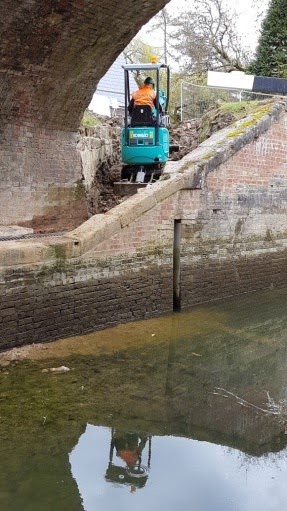
The restoration of the Western length of the Stroudwater requires the inspection and repair of the existing bridges at Whitminster (Occupation Bridge) and Newtown (Roving Bridge). Walk Bridge at Saul will be completely replaced with an arch bridge to replace the current level fixed bridge and flow metering station. 

After consideration of options it has been decided to use a modular pontoon to completely fill the gap between the banks under the bridges. This will enable a small platform to be erected and carried on the pontoon deck for the surveyor to get as close as is necessary to the brickwork for a detailed examination. The pontoon structure is similar to that of Kon-Tiki which is used by the landing stages team.

The modules were collected from the manufacturer by a team of SDC and CCT volunteers on Monday and left overnight at WD. The collectors were given a hands on demonstration of the method of assembly before loading into the van and tipper. The 55 double units and 10 single units were stacked, cajoled and squeezed into place and lashed down. The multiple bags of bits and steel work were moulded into the remaining spaces and voids.

The work of assembly was carried out on Tuesday by the SDC led volunteers. Access to the Occupation Bridge is possible in road vehicles in summer when the ground is dry. Our van and tipper do not cope well with ground which has seen a weekend of heavy rain on winter soaked turf. The only practicable route in is along the canal bank from the A38 roundabout and across a style. The 12 strong team set about carrying the units the half mile or so to the bridge. 

What about Stuart I hear you ask. Wasn’t she left by Occupation Bridge after the logging event during storm Erik? Well, she was-until last weekend when the WRG foresters continued the job started at Christmas at the viaduct end. They decided that having a boat would make their job less challenging. The 29 strong team hand balled the boat from one side of Stonepitts Bridge to the other where she remains.  

Splitting the route into 3 sections kept a steady delivery of units to the constructors. 3 pairs of volunteers carried the 55 11 kg double units in a relay across the fields and over the style over two and a half hours. A massive effort by the team of not so young and spritely volunteers. Bravo bravissimo!

The construction team assembled and locked into place all the units on the bank of the canal. The choice of assembly site was not ideal… Determined by the need to be close to the bridge the form was laid on a slope, albeit a gentle one, upwards to the lip of the bank. How much became evident after lunch the time came for the launch. Small undulations in the ground caused some difficulties for the assembly of a flat modular system. These were corrected but it became evident that the best place to achieve full tightness was on the only flat surface to hand.  The water. 


Launching was meant to be a simple slide from the bank. With all 12 pushing there was no movement, even with long levers movement was imperceptible. With all the effort concentrated on one corner movement was achieved. Progress was maintained by a wiggling action until full flotation occurred to no cheers at all. The pontoon was manoeuvred under the bridge where the locking pins were tightened and the handrails were fitted. Here we learnt that although very stable there is sufficient flexibility in the structure for the outer rows to respond to heavy weights placed on them. Adjustments to the rail fixings were done at arm’s length. 

 Now that the assembly is afloat it deserves a name. Keeping with the Thor Heyerdahl theme, Ra would seem appropriate for this new boat.
May God bless RA and all who sail on her. 

RA lies quietly admiring the Swans at Occupation Bridge


Scenes from Western Depot

By Buffs

February rushed past leaving memories of a month of four seasons. The bite of the winter snow, the blast of the wind and rain followed by the unusual balmy warmth which saw Western depot bathed in sun. The final week went out with a roar but did not produce the expected bounty of fallen timber for the log yard. Normal service returned in March with frost glistening on the pale fields around the canal. The bright and heightening sun was welcomed into the small engines workshop as Colin opened both doors on the container to encourage the warming golden rays to alight onto the benches and motors lying there.
The thin winter volunteer role call managed to fill the yard with the sounds of industry as Jasper was finished and returned to the water in readiness for the new season’s work and the dredger team set to repairing and replacing the rust ravaged cabin walls. Vince has mastered the staccato of spot welding of thin plate. Others have taken on the task of covering the yard (and its denizens) in a fine green sheen as the sound steel is prepared for repainting. 

On a slightly sadder note we said goodbye, hopefully not farewell, to John and Gill. This couple have been responsible for an inordinate amount of painting over the last 18 months or so. Joining us from the Tuesday/Thursday groups they worked quietly and methodically to prepare and paint both Ratty and Mole. With the personal understanding of a long partnership they achieved a high standard which was recognised by us all. It was fitting that they were the hosts on Ratty and Mole as these boats were formally named Jasper and Stuart before joining the CCT flotilla. The quality of finish on Patricia is also a product of their standards of work. We wish them well on their adventures on their new boat.


19 March 2019


Ham Mill Monday 18th March
by: Andy P.

An interesting start at 8am as the truck arrived to collect the 1 tonne trench box.  A tipper truck and no lifting equipment.  What are we supposed to do? Bob came up with a cunning plan.  Dismantle it.  The mini digger took the strain as the leg pins were eased out with a lump hammer.  More digger manoeuvres as the sides were grabbed and lifted on the truck, twice.  Excellent improvisation.

A mortar mix for Bob as he laid more bricks around the pipe outlet.  Mathew having to multi cut every one.  Slow and steady progress.
Duncan on mini digger graded the slope, but the Ham mud nearly got the better of him and the dumper on several occasions.  The excess being used to build up a bank near the amenity cabin where the last 5 laurel tress are being planted. Maurice was banksman and on essential traffic duties, as the tow path was opened and closed and moved about a bit most of the day.


Richard and Andy on neighbourly gardening duties to add a few more finishing touches.  We do get biscuits in return.  Dino the big fearsome dog, not even moving and there was a small hint of a tail wag.  Cracked it.

Numerous visitors today but not much time for catching up but John F and Ian M came to start the big mixer in readiness for the monster mixes we will need. We had tried the opposite of the utube video and Mathew got in spluttering into life only for it to splutter to death and stop.  John failed and the mixer is still dead.  We did pick the brains of the engineer who had just fixed BD so we have some options-ready mix might be one of them.  Hoorah. BD now back up and running but still needs some more TLC.

Let’s make some concrete was heard, so 3 mixers were wheeled down the slope and bucketed into the wall space behind the pipe.  It seems like years ago we started on this pipe, it was in fact Feb 26th 2018 but at long last after a very long delay and then so much work and effort, it is safe to say the pipe in now finished. That is apart from all the concrete to go on top of it, but that’s another story.


18 March 2019

Project 'DNF' - No.5 Refit

Great working party today, there were seven of us tackling numerous jobs on and off the boat.

The final repair welds to the second door were completed.  That is all the welding complete on the cabin.  Just need to fill and paint now.  The roof, which was really flaky an rough has been flattened ready for paint.  A bit for effort inside the cabin will prepare it for a complete repaint also.

Out on the boat, the outbreak of yellow paint has now spread across the whole boom, it looks a whole lot better now.  We are modifying the way the hoses are managed, with improvements to reduce the wear from rubbing that takes place.  Some welding will be necessary to complete this change.
Following a visit from our hydraulics man, the first hoses on the control block have now been fitted as has the accumulator for the control circuit, which resides in the control block tank.
Out on the deck, the tedious task of chipping back the paint to the early Neolithic period layer has begun.  There is more to do, but the result, once painted will be a vast improvement over what was there.

Later in the afternoon, our attention turned to the fly by wire throttle system.  In fact, we inserted a wire inside several pieces of recycled small bore hydraulic pipe so as to route it from the old throttle lever down to the floor level of the boat and then along to the engine, where it rises up and onto the throttle link mechanism.  A special coupler has been machined to couple the wire up.  There is a bit more to do with this next time to finish the job.
A successful and productive day,  many thanks to the team.  It is good to see the plumbing going back in.  More on Wednesday hopefully.

WRG Forrestry go cherry picking

(Phase 1B)

by: Jon P.

The future site of the re-connection of the Stroudwater Navigation and the River Frome at Lockham, Whitminster was blocked by 70 years of tree growth.   The largest culprit was a huge 3-trunked Crack Willow, with one trunk fallen horizontally in the canal, one at 30° and one at 60°.   WRG Forestry were asked to tackle the removal of this tree and, rather than use climbers to remove section from the height, they elected to use hired-in mechanization.   Steve P organised for Ermin Plant to deliver a rough terrain MEWP (mobile elevated work platform), more commonly known as a ‘cherry picker’, to Stonepitts Bridge.   Friday saw Nigel Lee of WRG Forestry deploying his team to the MEWP to access the furthest extremities of the Willow, firstly to inspect the tree for nesting birds, followed by chainsaw work, and interspersed with activity on the ground to chop up (or section) the fallen limbs and remove the brash to a bonfire.


Other members of the team attempted to winch the horizontal trunk to dry land, where it could also be sectioned.   Jon P led the gang retrieving the logs, and was responsible for the (less scary) ground-based chainsaw work.


On Saturday, WRG Forestry were joined by KESCRG, who de[played a team further east along the canal, and also worked on other tasks led by Steve P at Newtown Lock and Clowes Lock, Chalford.   The wind on Saturday, however, proved too strong – not for the stability of the MEWP, but because the tree was moving too much.

Sunday was calmer, so the MEWP was back in action again, leaving just simple trunks for later felling (they’re very thick – up to 1m in diameter, and very heavy).


Once again, a very successful long weekend and another task ‘ticked off the list’ of Phase 1B – Cotswold Canals Connected projects.

17 March 2019

Something Different - Barge Pulling

by: Myron

After an unspectacular weeks work, on Saturday the Boat Team undertook an entirely different activity. This was to support the Community Engagement Team of Cotswold Canals Connected. The idea for us was to bring a tug and hopper to the public event at Ebley, do some demonstrations and assist in the hopper pulling. This is a variation of the very popular barge pulling that Paul Weller has run many times at Ryeford locks, particularly for local schools. The strong wind presented a few challenges. In the end we modified our plans to pull a Margaret and hopper combo along the wharf outside Kitsch In. This turned out to be very successful and we did at least 6 tug/hopper pulls with the public. Emily and Molly from the Community Engagement Team were very good at drumming up members of the public to have a go. Kids loved it of course but quite a few adults had a go as well, amazed at the little effort it took to get well over 20 tonnes of metal moving on the water. We had Margaret running with a crew member ready on the controls, in case the wind should get things out of hand, but it wasn’t needed.

Thanks to Nick, John Sirett and Rachel for turning up on a very inauspicious day. Chris Godding and Malcolm Webb came to see us, and it was really nice to see Bob Poole and Peter Snelson as well. A few other volunteers came from other parts of the Trust as well.

The journey back was another matter. We were now into wind. Straight off the bollard the still strong wind took the bow of the hopper, nearly 100 feet away from the propeller, and took it onto the far bank. Any boater will tell you what it is like getting off a bank on the lee of the wind. It took us about four attempts. As we went through the flood gates the public gave us a round of applause, recognising the difficulty of the task. Then all the way back to Ryeford to drop the hopper off, the wind kept trying to blow the bow onto the bank but the team skilfully managed to keep it in the middle. We all learned about boating from that. Great boat handling on a nasty day. But a very satisfying day.


Thanks to Sam Sirett for the pictures.